Finding weeds that look like weed can be confusing when young plants develop narrow, serrated, or finger-like leaves resembling Cannabis. Several unrelated weeds share this foliage pattern, yet their stems, flowers, leaf arrangement, and growth habits reveal important differences.
Accurate identification of weeds that look like weed matters because appearance alone can lead to unnecessary removal or missed control of an unwanted species. Examining the whole plant provides stronger evidence than comparing one leaf with a photograph.
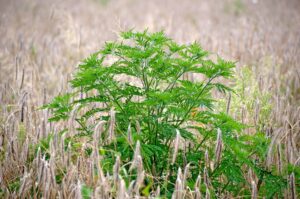
Common weed look-alikes occur in lawns, fields, roadsides, disturbed soil, and garden beds. Some spread through seeds, while others persist through roots or vigorous vegetative growth.
In this guide , we examine 15 weeds that can resemble Cannabis, emphasizing identification features, growth characteristics, and practical clues. The goal is to distinguish genuine cannabis from unrelated weeds and identify unwanted plants correctly.
15 Weeds That Look Like Weed
1. Common Ragweed (Ambrosia artemisiifolia) – Weed With Leaves Resembling Cannabis
Common ragweed is a widespread annual weed whose finely divided foliage can create confusion when viewed from a distance. Its lower leaves are often deeply lobed, while upper leaves may become narrower and less divided. Unlike Cannabis, ragweed leaves are not composed of the same distinct radiating serrated leaflets.
The plant commonly appears in disturbed soil, field edges, roadsides, vacant lots, and poorly maintained areas. It develops an upright green stem that can become moderately branched as the growing season progresses. Small inconspicuous flowers develop in elongated clusters rather than the conspicuous structures associated with cannabis plants.
Another useful clue is the plant’s flowering structure and pollen production. Common ragweed is an important source of airborne pollen during late summer and can spread through abundant seeds. Removing young plants before seed development can reduce future populations in gardens and other manageable areas.
Identification Features
- Finely divided leaves
- Annual growth
- Upright stems
- Small flowers
- Branched habit
- Abundant seeds
- Disturbed-site weed
Distinguishing Clues
- No cannabis leaflets
- Tiny flower clusters
- Different stem structure
2. Giant Ragweed (Ambrosia trifida) – Tall Weed With Cannabis-Like Leaves
Giant ragweed is a large annual weed that can produce deeply divided leaves with three or five prominent lobes. Young foliage can appear surprisingly similar to broad cannabis leaves, particularly before the plant develops its characteristic height and flowering structures. Its enormous mature size is one of the strongest clues separating it from Cannabis.
Plants commonly emerge in fertile disturbed soils, field margins, drainage areas, roadsides, and agricultural environments. Mature specimens can develop thick upright stems and substantial branching, producing a markedly different architecture from cannabis. Leaf shape also varies considerably as the plant develops, so several leaves should be examined during identification.
The plant produces relatively inconspicuous greenish flower structures rather than cannabis-like flowering clusters. It also produces seeds capable of remaining in soil and contributing to future populations. Management is generally easier when seedlings are removed before they become deeply rooted and produce mature seed.
Identification Features
- Deeply lobed leaves
- Tall growth
- Thick stems
- Annual weed
- Green flower clusters
- Large leaves
- Seed production
Distinguishing Clues
- Exceptional height
- Three-lobed foliage
- Thick central stem
3. Japanese Hop (Humulus japonicus) – Climbing Weed With Cannabis-Like Leaves
Japanese hop is a vigorous annual climbing weed with opposite, palmately divided leaves that can strongly resemble Cannabis foliage. Its leaves commonly have five to seven lobes with rough surfaces and serrated margins. Unlike Cannabis, Japanese hop climbs using rough stems and specialized structures that help it move through surrounding vegetation.
It commonly occurs along streams, woodland edges, roadsides, fences, and other disturbed habitats. The vine can spread across neighboring vegetation and form dense growth during favorable conditions. Its climbing habit is an important identification clue because Cannabis does not behave as a twining annual vine.
Japanese hop produces small flowers and later develops distinctive reproductive structures that differ from cannabis flowers. Seeds allow the annual plant to return in subsequent growing seasons. Removing young vines before seed production can help prevent establishment in gardens and other managed areas.
Identification Features
- Five-lobed leaves
- Serrated margins
- Climbing stems
- Annual vine
- Rough foliage
- Small flowers
- Seed production
Distinguishing Clues
- Climbing habit
- Opposite leaves
- Rough stems
4. Marsh Mallow (Althaea officinalis) – Broad-Lobed Weed Resembling Cannabis
Marsh mallow is a perennial herb that can develop palmately lobed leaves, creating a superficial resemblance to cannabis during vegetative growth. The leaves are generally softer and more rounded, with a somewhat velvety surface caused by fine hairs. That noticeably fuzzy texture is an important distinction from the typically more sharply defined Cannabis leaflets.
The plant favors moist soils, wetlands, drainage areas, and disturbed locations where adequate moisture is available. Its stems become upright and can support numerous leaves as the plant matures. Pale pink or mauve flowers provide another useful identification feature once reproductive growth begins.
Its perennial growth habit also distinguishes it from annual cannabis-like weeds. Underground structures allow the plant to survive unfavorable seasons and regenerate when suitable conditions return. Removing small plants before their root systems become established is generally easier than managing mature perennial growth.
Identification Features
- Lobed leaves
- Hairy foliage
- Perennial growth
- Upright stems
- Pink flowers
- Moist-soil preference
- Deep roots
Distinguishing Clues
- Velvety leaves
- Pink flowers
- Perennial habit
5. Velvetleaf (Abutilon theophrasti) – Weed With Soft Cannabis-Like Foliage
Velvetleaf is an annual broadleaf weed recognized by its large, heart-shaped leaves covered with fine soft hairs. Young foliage can cause confusion when viewed quickly because the leaves have pronounced veins and a distinctive pointed appearance. The leaves remain simple rather than developing the separate narrow leaflets characteristic of Cannabis.
It commonly grows in cultivated fields, disturbed soil, gardens, and areas where soil has recently been exposed. The plant develops an upright stem that becomes increasingly prominent as it matures. Yellow to orange flowers appear later in the season, followed by distinctive disk-shaped seed capsules that provide an excellent identification feature.
The dense hairs on both leaves and stems are particularly useful when distinguishing velvetleaf from cannabis-like weeds. Its substantial seed production can make established populations persistent in cultivated ground. Early removal before seed capsules mature can significantly reduce the number of viable seeds returned to the soil.
Identification Features
- Heart-shaped leaves
- Velvety texture
- Annual growth
- Upright stems
- Yellow flowers
- Seed capsules
- Broad foliage
Distinguishing Clues
- Soft hairy leaves
- Simple leaf structure
- Disk-like seedpods
6. Virginia Copperleaf (Acalypha virginica) – Weed With Serrated Leaves Resembling Cannabis
Virginia copperleaf is an annual broadleaf weed that can look somewhat cannabis-like when young because of its pointed, serrated leaves and upright growth. The foliage is generally oval to diamond-shaped rather than divided into multiple narrow leaflets, but the coarse margins can create a misleading first impression.
This weed commonly appears in gardens, cultivated fields, lawns, roadsides, and other disturbed soils. Its stems become increasingly branched as the plant matures, and the leaves are arranged alternately along the stems. Small greenish flowers develop in inconspicuous clusters, lacking the prominent flowering structure associated with Cannabis.
A closer examination of the leaf attachment provides an important identification clue. Virginia copperleaf has simple leaves attached individually to the stem, while Cannabis produces characteristic palmately compound leaves with several separate leaflets. The plant can produce numerous seeds, making removal before seed maturity useful for limiting future populations.
Identification Features
- Serrated leaves
- Simple foliage
- Annual growth
- Branched stems
- Green flowers
- Alternate leaves
- Seed production
Distinguishing Clues
- Simple leaves
- Alternate arrangement
- Small green flowers
7. Cleome (Cleome spp.) – Weed With Finger-Like Leaves
Cleome species can produce distinctive palmately arranged foliage with several narrow leaflets, making young plants particularly confusing when compared with Cannabis. The long, pointed leaflets and serrated edges can create a strong visual resemblance, especially when viewed from above.
These plants are commonly found in disturbed ground, roadsides, fields, gardens, and areas where soil has been recently cultivated. Depending on the species, plants may develop upright stems with leaves arranged alternately along the main stalk. Mature plants eventually produce conspicuous flowers that make identification considerably easier.
Cleome also develops elongated seed pods that differ substantially from Cannabis reproductive structures. Examining the entire plant rather than relying on the leaves alone is therefore important. The combination of flower form, seedpods, and overall upright growth provides reliable clues for separating Cleome from genuine cannabis.
Identification Features
- Narrow leaflets
- Palmately arranged leaves
- Serrated margins
- Upright growth
- Alternate leaves
- Showy flowers
- Long seedpods
Distinguishing Clues
- Long seedpods
- Distinct flowers
- Alternate foliage
8. Castor Bean (Ricinus communis) – Large-Lobed Weed That Can Resemble Cannabis
Castor bean is a large herbaceous plant with broad, deeply divided leaves that can initially resemble oversized Cannabis foliage. Its leaves commonly have seven to eleven pointed lobes with prominent veins and serrated margins. The enormous leaf size and strongly palmate shape become useful clues as the plant develops.
The species grows rapidly in warm regions and can occur around roadsides, waste areas, disturbed ground, gardens, and other open locations. Mature plants can become substantially larger than most cannabis plants, developing thick stems and very large leaves. Flowers occur in upright clusters and are followed by distinctive spiny seed capsules.
The seed capsules are among the easiest features for identification once the plant reaches maturity. Castor bean seeds contain ricin, so handling or ingesting the seeds can be dangerous, particularly for children and animals. Identification should therefore rely on the plant’s leaves, stems, flowers, and seed capsules rather than handling seeds unnecessarily.
Identification Features
- Deeply lobed leaves
- Large foliage
- Thick stems
- Rapid growth
- Upright habit
- Spiny capsules
- Warm-climate weed
Distinguishing Clues
- Huge leaves
- Spiny seed capsules
- Thick stems
9. Okra (Abelmoschus esculentus) – Plant With Cannabis-Like Lobed Leaves
Okra is a cultivated vegetable rather than a typical weed, but volunteer plants can appear in gardens, compost areas, and disturbed soil and may briefly resemble Cannabis. Its leaves can have three to seven pointed lobes with serrated edges, creating a superficial similarity during early vegetative growth.
The leaves are generally broad and somewhat rough, while the plant develops a strong upright stem as it matures. Large yellow flowers with dark centers are an especially useful identification feature. Once fruit develops, the elongated ridged okra pods make confusion with Cannabis highly unlikely.
Leaf arrangement and overall plant architecture also provide useful clues. Okra produces large individual leaves rather than the narrow radiating leaflets characteristic of Cannabis. Volunteer plants are usually easy to distinguish once their flowers or pods appear.
Identification Features
- Lobed leaves
- Upright stems
- Rough foliage
- Yellow flowers
- Dark flower centers
- Ridged pods
- Warm-season growth
Distinguishing Clues
- Yellow flowers
- Long pods
- Broad leaves
10. Sweetgum Seedlings (Liquidambar styraciflua) – Young Tree With Cannabis-Like Leaves
Young sweetgum seedlings can occasionally cause confusion because their juvenile leaves may have several pointed lobes arranged around a central point. The glossy green foliage and sharply pointed lobes can create a superficial resemblance to certain cannabis leaves when seedlings are viewed without examining the entire plant.
Sweetgum commonly regenerates in lawns, woodland edges, gardens, disturbed areas, and landscapes where mature trees are nearby. Seedlings develop woody stems as they age, eventually revealing their identity as young trees rather than herbaceous weeds. Mature leaves are typically star-shaped with five prominent lobes.
The developing stem provides one of the strongest clues for identification. Cannabis remains herbaceous, while sweetgum seedlings gradually develop woody tissue and a more tree-like growth pattern. Removing unwanted seedlings while they are small is considerably easier than dealing with established woody plants.
Identification Features
- Pointed lobes
- Star-shaped leaves
- Woody development
- Tree seedling
- Glossy foliage
- Alternate leaves
- Rapid establishment
Distinguishing Clues
- Woody stem
- Star-shaped foliage
- Tree growth
11. Japanese Anemonewort (Erechtites hieraciifolius) – Tall Weed With Narrow Lobed Leaves
Japanese anemonewort is an annual broadleaf weed that can produce narrow, irregularly lobed foliage capable of causing confusion with Cannabis at a quick glance. Its leaves are generally elongated and sharply toothed, while the plant develops an upright, branching form.
The species commonly colonizes disturbed ground, forest clearings, roadsides, burned areas, and recently cleared sites. Plants can grow rapidly and may become considerably taller than expected from their early seedling appearance. Flower heads eventually develop at the ends of branches, providing an important identification feature.
Unlike Cannabis, the foliage does not consist of multiple separate radiating leaflets. The leaves remain attached as individual blades along the stem, and the plant’s flowering structures are completely different. Looking at several leaves along the stem can therefore resolve confusion quickly.
Identification Features
- Narrow leaves
- Irregular lobes
- Toothed margins
- Upright growth
- Branched stems
- Annual habit
- Small flower heads
Distinguishing Clues
- Individual leaves
- Branched flower heads
- Tall slender habit
12. Prickly Lettuce (Lactuca serriola) – Weed With Serrated, Divided-Looking Leaves
Prickly lettuce is a biennial weed whose young leaves can appear unusually narrow and deeply toothed. The foliage sometimes creates a cannabis-like impression because of its pointed projections and irregular margins, particularly when the plant is viewed from a distance.
It commonly grows in roadsides, vacant lots, fields, gardens, construction sites, and other disturbed environments. Mature plants develop a tall central stalk with numerous leaves arranged along the stem. The underside of each leaf often has a prominent row of prickles along the central midrib, which is a highly useful identification feature.
The plant later produces numerous small yellow flower heads rather than Cannabis-like flowers. Its milky latex and prickly midrib provide additional clues during identification. Examining the underside of the leaves can therefore be especially helpful when distinguishing this species from cannabis.
Identification Features
- Toothed leaves
- Prickly midrib
- Milky sap
- Tall stems
- Yellow flowers
- Biennial growth
- Disturbed-site weed
Distinguishing Clues
- Prickly midrib
- Yellow flower heads
- Milky sap
13. Carolina Bristlemallow (Modiola caroliniana) – Low-Growing Weed With Lobed Leaves
Carolina bristlemallow is a low-growing broadleaf weed with rounded to palmately lobed leaves that can appear somewhat cannabis-like during early growth. Its foliage is usually less finely divided than Cannabis, but the pointed lobes and serrated margins can cause temporary confusion.
This species often grows in lawns, gardens, roadsides, disturbed soil, and moist or moderately fertile locations. Instead of developing a tall central structure, it can spread outward along the ground and form a low mat. Small orange to reddish flowers eventually provide a useful identification characteristic.
Its growth habit is one of the clearest ways to distinguish it from Cannabis. Carolina bristlemallow tends to remain low and spreading, while Cannabis normally develops a distinctly upright herbaceous architecture. The small fruits that follow flowering also differ substantially from cannabis reproductive structures.
Identification Features
- Lobed leaves
- Low growth
- Spreading stems
- Serrated margins
- Small flowers
- Annual or perennial behavior
- Disturbed-site growth
Distinguishing Clues
- Low-growing habit
- Orange flowers
- Spreading stems
14. Wild Carrot (Daucus carota) – Fine Foliage That Can Look Cannabis-Like
Wild carrot produces finely divided foliage that may initially resemble the delicate leaf structure of Cannabis. Its leaves are highly dissected, producing numerous narrow segments that can create confusion when only the foliage is considered.
The plant commonly appears along roadsides, fields, pastures, lawns, and unmanaged areas. It generally develops a tall flowering stalk during its second year, eventually producing characteristic white flower clusters arranged in umbrella-shaped structures. The foliage is typically much finer and softer than the distinct serrated leaflets of Cannabis.
Flower structure provides the strongest identification clue. Wild carrot produces a flat-topped cluster of numerous tiny white flowers rather than individual Cannabis-like flowers. The plant’s biennial growth cycle is another important distinction when identifying established populations.
Identification Features
- Finely divided leaves
- Narrow leaf segments
- Biennial growth
- Tall flower stalk
- White flower clusters
- Umbel-shaped flowers
- Roadside growth
Distinguishing Clues
- White flower umbels
- Very fine foliage
- Biennial habit
15. Sawtooth Blackberry (Rubus argutus) – Prickly Plant With Cannabis-Like Leaflets
Sawtooth blackberry is a perennial bramble that can produce compound leaves with several serrated leaflets, creating a superficial resemblance to Cannabis. The leaflets are usually arranged in groups of three or five and have sharply toothed margins, making young shoots particularly easy to misidentify from a distance.
The plant commonly grows along woodland edges, fences, roadsides, fields, and unmanaged areas. Its long stems can arch outward and become heavily armed with prickles, providing an immediate clue that it belongs to the bramble group rather than Cannabis. White flowers eventually develop, followed by blackberry fruits.
The combination of prickles, woody stems, and fruit makes identification straightforward once the plant matures. Unlike Cannabis, sawtooth blackberry is a perennial woody plant that can regenerate from established crowns and roots. When removal is necessary, dealing with the root system is important because cutting the visible stems alone may not prevent regrowth.
Identification Features
- Compound leaves
- Three or five leaflets
- Serrated margins
- Prickly stems
- Woody growth
- White flowers
- Blackberry fruit
Distinguishing Clues
- Sharp prickles
- Woody stems
- Blackberry fruit
Weeds That Look Like Weed FAQ’S
1. What weeds look like weed?
Several weeds can resemble Cannabis because they develop serrated, lobed, or compound-looking leaves. Common ragweed, giant ragweed, Japanese hop, castor bean, cleome, velvetleaf, wild carrot, and blackberry can create visual confusion during early growth.
2. How can you tell if a plant is Cannabis or a weed?
Examine the entire plant rather than relying on one leaf. Cannabis typically has palmately compound leaves with several distinct serrated leaflets, while many look-alike weeds have simple leaves with deep lobes, different leaf arrangements, unusual flowers, woody stems, prickles, or climbing growth.
3. What weed has leaves that look like Cannabis?
Japanese hop, giant ragweed, cleome, castor bean, and some other plants can produce foliage that superficially resembles Cannabis. Their mature growth habits, flowers, stems, and reproductive structures provide stronger identification clues.
4. Can ragweed look like Cannabis?
Yes, young ragweed can sometimes look similar to Cannabis because its leaves may be deeply divided or finely lobed. Ragweed does not produce the distinct collection of separate serrated leaflets characteristic of Cannabis, and its flowers and overall growth structure are different.
5. What plant has five leaves that look like Cannabis?
Several unrelated plants can have five-lobed or five-part leaves, including Japanese hop and some members of the mallow and bramble groups. The number of lobes or leaflets alone is not sufficient for accurate identification.
6. What weed looks like Cannabis but has thorns?
Some blackberry and bramble species can have compound leaves with serrated leaflets that superficially resemble Cannabis. Their prickly stems, woody growth, flowers, and eventual berries provide strong clues that they are unrelated to Cannabis.
7. Why do so many weeds look like Cannabis?
Many plants independently develop lobed, serrated, or divided leaves because these structures can help increase leaf surface area and interact efficiently with sunlight. Similar leaf shapes do not necessarily indicate that plants are closely related, which is why identification should include stems, flowers, fruits, and growth habits.
Conclusion
In conclusion, weeds that look like weed can be difficult to identify when only young foliage is available. Several unrelated species develop serrated, lobed, or compound-looking leaves that can create a superficial resemblance to Cannabis.
The best identification method is to examine the entire plant rather than relying on leaf appearance alone. Leaf arrangement, stem structure, flowers, fruits, hairs, prickles, growth habit, and habitat can provide much stronger evidence.
Common ragweed, giant ragweed, Japanese hop, castor bean, cleome, velvetleaf, wild carrot, and blackberry each have characteristics that separate them from genuine Cannabis. Recognizing these differences can make weed identification more accurate and prevent unnecessary removal of desirable plants.
For difficult cases, the runner-up approach is to photograph the complete plant at several stages of growth and compare multiple characteristics. A whole-plant assessment is consistently more reliable than matching a single Cannabis-like leaf to an online photograph.
Recent Posts
Spring fertilization supports healthy leaf development, root activity, and productive shoot growth when apple trees have insufficient soil nutrients. Selecting an appropriate fertilizer requires...
Cucumbers (Cucumis sativus) are vigorous, fast-growing vines that can produce abundant harvests when their roots receive enough water, warmth, and balanced nutrition. The best fertilizer for cukes in...