A vinegar weed killer recipe with Dawn soap is a simple homemade option for treating young weeds growing in driveway cracks, sidewalk joints, gravel paths, patios, and other areas where desirable plants are absent. Vinegar provides the acidic contact action, while Dawn dish soap can help the solution spread more evenly across leaf surfaces.
The concentration of acetic acid matters because ordinary household vinegar and concentrated vinegar products have very different strengths. Weed species, plant maturity, weather, sunlight, spray coverage, and rainfall can also determine whether the treatment merely scorches the foliage or provides useful suppression.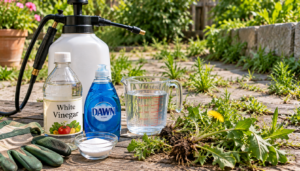
Because vinegar is non-selective, the spray can injure desirable plants whenever it contacts their foliage. Stronger vinegar formulations also require additional care during handling, making accurate measurement, protective equipment, and label directions particularly important.
In this guide , you will learn how to make a vinegar weed killer recipe with Dawn soap in 10 easy steps, how to apply it correctly, how much soap to use, when to spray, and what to expect after treatment.
Vinegar Weed Killer Recipe With Dawn Soap
1. Choose The Right Vinegar
The first step is choosing the vinegar you intend to use. Household white vinegar commonly contains about 5% acetic acid, while products marketed specifically for weed control can contain substantially higher concentrations.
For small, young annual weeds, household vinegar may cause noticeable foliage injury when the leaves are thoroughly wetted. However, it should not be treated as a guaranteed permanent solution for mature perennial weeds because contact injury to the leaves does not necessarily eliminate the underground root system.
If you are using concentrated vinegar, check the product label before preparing the spray. A higher acetic-acid concentration changes the handling requirements as well as the potential for plant injury, so it should never be treated as though it were ordinary kitchen vinegar.
2. Measure The Vinegar
For the basic homemade mixture, measure 1 gallon of vinegar accurately rather than estimating the quantity.
Accurate measurement keeps the formulation consistent and makes it easier to understand how the treatment performs. If you change the volume of vinegar, adjust the amount of soap proportionally rather than adding an arbitrary quantity.
Pour the measured vinegar into a clean, suitable pump sprayer or mixing container. Avoid using equipment that may contain residues from incompatible pesticides or other chemicals.
3. Measure The Dawn Soap
Measure 1 tablespoon of Dawn dish soap for each gallon of vinegar for the basic recipe.
The purpose of the soap is primarily to improve wetting and spreading across the leaf surface. It is not the main weed-killing ingredient, so adding substantially more soap does not automatically make the mixture more effective.
Use an actual measuring spoon rather than pouring soap directly from the bottle. Consistent measurements produce a more predictable spray and reduce unnecessary foaming.
4. Add The Dawn To The Vinegar
Add the measured Dawn slowly to the vinegar.
Pouring it gradually helps prevent excessive foaming, particularly when the mixture is prepared inside a pump sprayer. There is no need to create a heavily sudsy solution.
Once the soap has been added, close the sprayer securely and gently mix the contents. Avoid vigorous shaking because excessive agitation can create foam without providing any meaningful benefit to weed control.
5. Prepare The Sprayer
Before applying the mixture, inspect the sprayer to make sure the tank, hose, wand, nozzle, and seals are functioning properly.
A sprayer capable of producing a controlled, targeted spray is preferable to equipment that produces excessive mist. Fine droplets can drift more easily, which is particularly undesirable when desirable plants are growing nearby.
If possible, dedicate the sprayer to weed-control applications. Clearly identifying the equipment also reduces the possibility of accidentally using herbicide-contaminated equipment for fertilizer, foliar feeds, or other plant-care applications.
6. Choose The Right Time To Spray
Weather can make a substantial difference to the performance of a contact weed treatment.
Choose a dry, calm period when the weed foliage is dry and there is sufficient time for the spray to remain on the leaves. Warm, sunny conditions can encourage rapid visible injury, although the exact response depends on the weed and the formulation.
Avoid spraying immediately before rainfall because water can dilute or remove the treatment from the foliage. Wind should also be avoided because drifting droplets can land on lawn grass, flowers, vegetables, shrubs, and other plants that you intend to keep.
7. Spray The Weed Foliage Thoroughly
Apply the solution directly to the unwanted weeds, aiming for thorough coverage of the exposed foliage.
Because vinegar acts primarily where it contacts plant tissue, coverage is critical. A few droplets landing on a large plant may produce only scattered injury, whereas adequately wetting the foliage provides much greater contact with the treatment.
At the same time, avoid unnecessary runoff. The objective is to wet the target leaves rather than saturate the surrounding soil or allow the solution to flow onto desirable vegetation.
8. Protect Desirable Plants
Take extra care when weeds are growing close to plants you want to preserve.
Vinegar is non-selective, which means it does not recognize the difference between a weed and a desirable crop or ornamental plant. If enough spray reaches green foliage, that plant can also suffer contact injury.
When treating weeds near valuable plants, use a targeted spray pattern and consider shielding nearby foliage with a physical barrier. Spraying slowly and deliberately is much safer than attempting to cover a large area quickly.
9. Allow The Weeds To Show A Response
After application, allow the treatment time to work rather than immediately applying another dose.
Susceptible foliage may begin to wilt, scorch, or brown within hours, with symptoms becoming more obvious over the following day. The speed and severity of the response depend on the vinegar concentration, weed species, growth stage, environmental conditions, and quality of coverage.
Do not assume that brown foliage automatically means the entire weed has died. Contact treatments can destroy above-ground tissue while established roots, crowns, rhizomes, or other underground structures remain alive.
10. Check For Regrowth
The final step is inspecting the treated area for surviving tissue and new growth.
This is particularly important when treating perennial weeds. If the foliage turns brown but new shoots subsequently emerge, the plant has survived below ground and may require a different or integrated control strategy.
For persistent weeds, consider combining targeted treatment with appropriate physical removal, cultivation, mulching, mowing, or another weed-management method suited to the species and location.
The objective should not simply be to make the weed brown. Effective weed management means reducing the plant’s ability to survive, regenerate, and produce new seed.
The Correct Vinegar And Dawn Soap Ratio
For the simple formulation described in this guide, use:
1 gallon of vinegar + 1 tablespoon of Dawn dish soap.
The ratio is deliberately simple because Dawn is being used primarily as a surfactant to improve coverage.
Do not assume that adding more dish soap will compensate for weak vinegar, poor application timing, inadequate foliage coverage, or a weed species that naturally tolerates contact injury.
The vinegar concentration is much more important to the chemistry of the treatment than the quantity of dish soap.
Can 5% Vinegar Kill Weeds?
Yes, 5% vinegar can injure and kill some young weeds, particularly annual weeds with tender foliage.
Its performance becomes less dependable as weeds become older, larger, or more difficult to control. Perennial weeds can be especially challenging because their underground structures may remain alive even after the foliage has been severely damaged.
For that reason, 5% household vinegar is best viewed as a simple contact treatment rather than a universal replacement for professional weed-control products.
Can You Use 30% Vinegar With Dawn Soap?
Products containing 30% acetic acid are considerably more concentrated than ordinary household vinegar.
They can cause severe contact injury to vegetation, but they also present significantly greater handling hazards. Such products should be used only according to their label directions, with the protective equipment and application procedures specified by the manufacturer.
Never mix concentrated vinegar with other household chemicals simply to make a stronger weed killer.
In particular, never mix vinegar with bleach or ammonia.
How Long Does Vinegar And Dawn Take To Kill Weeds?
Visible injury can develop within several hours under favorable conditions, with more obvious browning and desiccation often appearing within approximately a day.
That does not mean every weed will be permanently controlled within 24 hours.
Annual weeds may be severely damaged, while established perennials can recover from underground tissues. Therefore, inspect the treated area over the following days and weeks rather than judging success solely from the initial brown appearance.
Why Do Weeds Come Back After Vinegar Treatment?
The most common reason is that the treatment damaged the foliage without eliminating the plant’s underground structures.
Perennial weeds can store energy in roots, rhizomes, crowns, tubers, or other structures below the soil surface. When the foliage is destroyed, those reserves can support the development of new shoots.
This is why repeated browning does not necessarily equal long-term control.
If a particular perennial continues returning, identify the species and select a management method designed for its growth habit.
When Is Vinegar Weed Killer Most Useful?
A homemade vinegar treatment is most useful for targeted spot treatment, especially where weeds are growing in places without desirable vegetation.
Examples include:
- Driveway cracks
- Walkway joints
- Gravel surfaces
- Patio gaps
- Paver joints
- Fence-line cracks
- Hardscape edges
It is less suitable for treating weeds throughout a lawn or garden bed because desirable plants can also be damaged.
Common Mistakes When Using Vinegar And Dawn
Spraying In Wind
Wind increases the possibility of spray drift and accidental injury to desirable plants.
Spraying Before Rain
Rain can remove or dilute the treatment before sufficient contact occurs.
Using Too Much Dawn
Extra soap does not automatically increase herbicidal activity.
Treating Mature Perennial Weeds Like Annuals
Large perennial weeds may recover even after severe foliage injury.
Spraying The Entire Garden
Vinegar is non-selective and can damage crops, flowers, turf, and ornamentals.
Ignoring Vinegar Concentration
Five-percent household vinegar and concentrated acetic-acid products should not be treated as interchangeable.
Reapplying Too Quickly
Give the first treatment time to show its full visible response before deciding what to do next.
How To Improve Long-Term Weed Control
The strongest weed-management strategy is rarely based on one spray alone.
Start by identifying the weed and determining whether it is an annual or perennial. Then consider its location, reproductive method, root system, and stage of growth.
Young annual weeds are often easier to manage before they flower and produce seed. Removing them early can reduce the number of seeds returned to the soil.
For perennial weeds, combine appropriate control methods where necessary. Physical removal, cultivation, mulching, mowing, improved ground cover, and properly selected herbicides can all have roles depending on the weed and growing environment.
Good weed management is ultimately about preventing establishment and reproduction, not simply destroying visible foliage.
Safety When Making Vinegar Weed Killer
Treat concentrated vinegar with respect.
Wear suitable gloves and eye protection during preparation and application, particularly when working with higher-acetic-acid products. Avoid spraying into your face, breathing spray mist, or allowing the solution to remain on your skin.
Keep the mixture away from children and pets during application and follow the product label for any required precautions or re-entry restrictions.
Store vinegar products securely and keep concentrated formulations in their original labeled containers.
Most importantly, never mix vinegar with bleach, ammonia, or other household chemicals. Combining household chemicals can produce dangerous reactions or gases.
Vinegar Weed Killer Recipe With Dawn Soap FAQ’S
1. What Is The Best Vinegar Weed Killer Recipe With Dawn Soap?
A simple starting formulation is 1 gallon of vinegar with 1 tablespoon of Dawn dish soap. The vinegar provides the principal contact action, while the soap helps the solution spread across foliage.
2. How Much Dawn Do You Put In A Gallon Of Vinegar?
Use approximately 1 tablespoon of Dawn dish soap per gallon of vinegar for the basic formulation. More soap is not necessarily more effective.
3. Can I Use 5% Vinegar To Kill Weeds?
Yes. Five-percent household vinegar can cause substantial injury to young, susceptible weeds, although established perennial weeds may survive and regenerate.
4. Does Dawn Soap Kill Weeds By Itself?
Dawn is not the primary active ingredient in this formulation. Its main role is to help the liquid wet and spread across the leaf surface.
5. Will Vinegar And Dawn Kill Grass?
Yes. Vinegar is non-selective and can damage grass when its foliage receives sufficient spray. Do not use the mixture as a blanket treatment over a lawn.
6. Will Vinegar And Dawn Kill Weed Roots?
It may not. Vinegar primarily damages plant tissue that it contacts, while established perennial weeds can retain living underground structures capable of producing new shoots.
7. Can I Use Vinegar And Dawn In A Vegetable Garden?
Extreme care is necessary because the mixture can injure vegetables and other desirable plants. Targeted physical removal or a control method specifically appropriate for the crop and weed situation is generally preferable where valuable plants are growing.
Conclusion
In conclusion, making a vinegar weed killer recipe with Dawn soap is straightforward when the ingredients are measured accurately and the solution is applied directly to unwanted foliage. Vinegar provides the contact action, while a small amount of Dawn can improve wetting and coverage across the leaf surface.
The best results come from treating young weeds during dry, calm weather and avoiding contact with desirable vegetation. A runner-up strategy for persistent weeds is to combine targeted contact treatment with physical removal or another appropriate control method rather than repeatedly relying on foliage burn alone.
Remember that visible browning does not always indicate permanent control, particularly when dealing with mature perennial weeds. Identifying the weed, understanding its growth habit, preventing seed production, and choosing the appropriate management technique will produce more reliable long-term results.
If you are ready to treat a small weed problem, measure the vinegar and Dawn carefully, prepare the sprayer safely, choose a suitable weather window, and apply the solution only where unwanted vegetation is growing.
Recent Posts
Spring fertilization supports healthy leaf development, root activity, and productive shoot growth when apple trees have insufficient soil nutrients. Selecting an appropriate fertilizer requires...
Cucumbers (Cucumis sativus) are vigorous, fast-growing vines that can produce abundant harvests when their roots receive enough water, warmth, and balanced nutrition. The best fertilizer for cukes in...