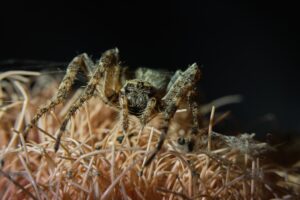
Choosing the right pest control for wolf spiders starts with understanding how these large hunting spiders behave. Unlike many web-building spiders, wolf spiders actively run after prey, and they can enter homes through gaps around doors, windows, foundations, pipes, and other openings.
Wolf spiders are predators that feed on insects and other arthropods, so their presence can sometimes indicate that a building or landscape has an available food supply. Penn State Extension notes that wolf spiders are generally not aggressive and may bite if handled, while typical reactions are localized and serious medical consequences have not been reported.
The most effective approach is usually integrated pest management rather than relying on one spray or repellent. Sealing entry points, repairing screens, reducing outdoor lighting that attracts insects, removing hiding places, and controlling the insects that serve as prey can all reduce encounters with wandering spiders.
In this guide , we compare 10 of the best pest control options for wolf spiders based on exclusion, habitat management, monitoring, removal, insect control, convenience, and suitability for indoor and outdoor areas. Chemical treatments are included where appropriate, but pesticide labels should always be followed.
Top 10 Best Pest Control For Wolf Spiders
1. Door Sweeps – Best Pest Control for Wolf Spiders Under Doors
A door sweep is the best pest control for wolf spiders under doors when spiders are entering through the gap between an exterior door and the threshold. Closing this opening creates a physical barrier rather than attempting to kill spiders after they enter.

Wolf spiders are ground-running hunters, so gaps near floor level can provide convenient access into garages, basements, utility rooms, and homes. A properly fitted sweep can reduce this pathway while also helping exclude other crawling insects.
Inspect the entire door frame rather than only the bottom edge. Weather stripping and side gaps can also provide access, particularly around older exterior doors.
A door sweep is most effective when combined with other exclusion measures. Penn State Extension specifically recommends fixing gaps around doors as part of wolf spider management.
Pros
- Blocks door gaps
- Long-term solution
- No pesticide
- Easy installation
- Low maintenance
- Multi-pest benefit
- Preventive approach
Cons
- Installation required
- Does not seal walls
- Door alignment matters
2. Caulk and Sealant – Best Pest Control for Wolf Spider Entry Points
Caulk and appropriate sealant are the best pest control for wolf spider entry points when cracks and gaps around windows, foundations, pipes, or utility lines provide access into the building.

Small openings can be easy to overlook, particularly around window frames, utility penetrations, foundation joints, and areas where different building materials meet.
Sealing these routes is more durable than repeatedly removing individual spiders. Penn State Extension recommends caulking cracks around window frames, pipes, and wires, while Minnesota Extension recommends sealing cracks and gaps around foundations, doors, and ground-level windows.
Before sealing, inspect the building carefully and determine whether the opening needs a flexible sealant, mesh backing, or another appropriate material.
Pros
- Blocks entry
- Long-lasting
- No pesticide
- Low maintenance
- Affordable
- Preventive
- Multi-pest benefit
Cons
- Requires inspection
- Preparation needed
- Not for every opening
3. Sticky Traps – Best Indoor Monitor for Wolf Spiders
Sticky traps are the best indoor monitor for wolf spiders when you need to determine where spiders are traveling. They can help reveal activity along walls, under furniture, and in other quiet areas.


Minnesota Extension recommends sticky traps as a way to check for the presence of spiders, with placement along walls, under furniture and appliances, and in other undisturbed locations.
Their main value is monitoring rather than eliminating the underlying reason spiders are present. If traps repeatedly catch spiders in one location, inspect nearby cracks, doors, windows, and insect activity.
Keep traps away from children and pets where necessary and follow the product instructions.
Pros
- Easy monitoring
- No spray
- Low maintenance
- Identifies activity
- Useful indoors
- Inexpensive
- Easy placement
Cons
- Does not seal entry
- Limited coverage
- Requires replacement
4. Vacuum Cleaner – Best Pest Control for Individual Wolf Spiders
A vacuum cleaner is the best pest control for individual wolf spiders when you want immediate removal without applying insecticide. A hose attachment allows you to remove a spider from floors, walls, corners, or other accessible surfaces.

Vacuuming is particularly useful when only a few spiders are being encountered indoors. It also allows webs, loose debris, and other material to be removed at the same time.
Minnesota Extension recommends removing spider webbing with a broom or vacuum and destroying egg sacs when found.
For repeated activity, however, vacuuming should be combined with exclusion and habitat management. Removing individual spiders does not prevent new ones from entering.
Pros
- Immediate removal
- No pesticide
- Easy to perform
- Removes debris
- Useful indoors
- No chemical residue
- Convenient
Cons
- Does not prevent entry
- Repeated activity requires more work
- Egg sacs need attention
5. Exterior Insect Control – Best Pest Control for Wolf Spiders’ Food Source
Exterior insect control is the best pest control for wolf spiders’ food source when high populations of insects are attracting hunting spiders around a building. Wolf spiders feed on insects and other arthropods, so reducing available prey can make the surrounding area less attractive.

This approach should focus on the insects responsible for the problem rather than indiscriminately treating every arthropod. Integrated pest management recommends identifying the actual pest before selecting a control method.
Reducing outdoor lighting can also help because lights attract insects that can subsequently provide food for spiders. Minnesota Extension recommends reducing outside lighting and using yellow lights that are less attractive to insects where appropriate.
If an insecticide is necessary, use only a product labeled for the specific site and target pest.
Pros
- Addresses food source
- Reduces insect activity
- Can reduce spider pressure
- Useful outdoors
- Integrated approach
- Multiple applications possible
- Preventive potential
Cons
- Targets insects rather than spiders
- Requires identification
- Pesticide precautions apply
6. Exterior Perimeter Insecticide – Best Chemical Pest Control for Wolf Spiders
An exterior perimeter insecticide is the best chemical pest control for wolf spiders when exclusion and nonchemical measures have not adequately reduced indoor invasion. A properly labeled exterior treatment can target cracks, crevices, and areas where wandering spiders enter or hide.

Minnesota Extension states that a light application of a broad-spectrum insecticide on the exterior of a home may reduce invasion by wandering spiders. It recommends treating areas such as cracks, crevices, and spaces under siding, provided the product is labeled for exterior building use.
Chemical control should not automatically be the first step. Penn State’s integrated pest management guidance emphasizes prevention, exclusion, monitoring, nonchemical methods, and reduced pesticide use before escalating to chemical control.
Always follow the pesticide label regarding application sites, personal protective equipment, pets, children, reentry, and environmental precautions.
Pros
- Targeted exterior treatment
- Useful for invasion
- Can treat hiding areas
- Professional-style approach
- Repeatable
- Covers entry zones
- Fast application
Cons
- Requires label compliance
- Chemical exposure concerns
- Not necessary for every situation
7. Outdoor Lighting Reduction – Best Preventive Control for Wolf Spiders
Reducing outdoor lighting is the best preventive control for wolf spiders when nighttime insect activity is contributing to spider activity around doors and windows. Outdoor lights can attract insects, which in turn can provide hunting opportunities for spiders.

Minnesota Extension specifically recommends reducing outdoor lighting and suggests yellow lights that are less attractive to insects than certain conventional outdoor lighting. It also recommends positioning security lights away from the building rather than directly above the door.
This approach does not directly kill wolf spiders. Instead, it modifies the environment so fewer insects gather around potential entry points.
Combining lighting changes with door sealing and screen repair can create a more comprehensive exclusion strategy.
Pros
- Chemical-free
- Low maintenance
- Reduces insect attraction
- Useful at night
- Energy-efficient options
- Preventive
- Easy to implement
Cons
- Does not kill spiders
- Results vary
- Requires other measures
8. Yard and Vegetation Management – Best Outdoor Pest Control for Wolf Spiders
Yard and vegetation management is the best outdoor pest control for wolf spiders when landscaping provides abundant shelter close to the building. Keeping vegetation managed can reduce sheltered areas where wandering spiders and their prey may occur.

Minnesota Extension recommends keeping grassy and weedy areas near buildings short and trimming shrubs or other plants that directly contact the house. It also recommends removing piles of bricks, firewood, and other debris that can provide shelter for spiders.
The goal is not to eliminate spiders from the landscape. Spiders are beneficial predators, and extension guidance does not recommend trying to eradicate them from lawns, gardens, and landscapes.
Instead, concentrate management around the building where spider encounters are unwanted.
Pros
- Chemical-free
- Reduces shelter
- Improves access
- Benefits landscape
- Preventive
- Reduces clutter
- Multi-pest benefit
Cons
- Requires regular maintenance
- Does not eliminate spiders
- Large yards require more work
9. Window and Door Screens – Best Pest Control for Wolf Spiders Entering Through Windows
Repairing window and door screens is the best pest control for wolf spiders entering through windows when damaged or poorly fitted screens provide an easy route indoors. Properly fitted screens can prevent spiders and other insects from entering while maintaining ventilation.

Minnesota Extension recommends replacing screens that fit poorly or are damaged as part of preventing wandering spiders from entering homes.
Inspect screens carefully for tears, loose edges, gaps, and openings around frames. Even a relatively small damaged section can provide access to insects and other small organisms.
Screen repair is particularly useful when spider activity is concentrated around windows or screened doors.
Pros
- Physical barrier
- No chemicals
- Long-term benefit
- Improves ventilation
- Multi-pest protection
- Easy maintenance
- Preventive
Cons
- Damaged screens need repair
- Does not address foundation gaps
- Requires inspection
10. Professional Integrated Pest Management – Best Comprehensive Pest Control for Wolf Spiders
Professional integrated pest management is the best comprehensive pest control for wolf spiders when spider activity is persistent, widespread, or difficult to resolve with basic exclusion and sanitation.

IPM focuses on identifying the pest, determining why it is present, reducing conditions that support it, monitoring activity, and using chemical control only when appropriate. Penn State describes IPM as combining prevention, monitoring, nonchemical methods, pesticide selection, reduced pesticide use, and evaluation.
A professional can inspect likely entry points, identify contributing insect populations, evaluate outdoor conditions, and determine whether a targeted pesticide treatment is warranted.
Professional treatment can be particularly useful when repeated DIY applications have not addressed the underlying conditions. Any pesticide application should still comply with the applicable product label and local requirements.
Pros
- Comprehensive assessment
- Identifies entry routes
- Targets contributing pests
- Professional inspection
- Integrated strategy
- Monitoring included
- Customized approach
Cons
- Higher cost
- Professional service required
- Treatment varies by property
7 Essential Features to Consider When Choosing Wolf Spider Pest Control
1. Identification
Confirm that the spiders are actually wolf spiders before selecting a treatment. Penn State describes wolf spiders as large hunting spiders that do not rely on capture webs.
2. Entry-Point Control
Inspect doors, windows, foundations, pipes, wires, vents, and other openings. Sealing access points is one of the most important long-term prevention measures.
3. Food-Source Management
Wolf spiders hunt insects and other arthropods. Reducing excessive insect activity around the building can therefore reduce the conditions attracting hunting spiders.
4. Outdoor Habitat
Keep vegetation near the building managed and remove unnecessary piles of debris, firewood, bricks, and other potential shelter.
5. Monitoring
Sticky traps, visual inspection, and regular checks around doors and windows can help identify where spider activity is concentrated.
6. Chemical Selection
If insecticide is necessary, select only products whose current labels permit the intended site and target use. Extension guidance recommends targeted applications rather than indiscriminate surface treatments or fogging.
7. Long-Term Prevention
A successful program should reduce future entry and the conditions supporting spider activity rather than simply killing individual spiders that appear indoors.
7 Frequently Asked Questions
1. What is the best pest control for wolf spiders?
Exclusion is one of the most useful long-term approaches. Seal cracks and gaps, repair screens, install appropriate door sweeps, reduce outdoor insect attraction, and remove nearby shelter before considering pesticide applications.
2. What attracts wolf spiders to a house?
Wolf spiders may enter homes while hunting for prey or seeking protected areas. Insects around exterior lighting, vegetation touching the building, debris, and openings around doors and foundations can all contribute to conditions that increase encounters.
3. How do I keep wolf spiders out of my house?
Seal cracks around the foundation, doors, windows, pipes, and wires; repair damaged screens; keep vegetation from directly contacting the building; and remove piles of debris near the structure.
4. What kills wolf spiders instantly?
Direct pesticide contact can kill spiders when a product is labeled for that use, but indiscriminate pesticide application is not generally necessary for occasional wolf spiders. For individual indoor spiders, physical removal with a vacuum can be a simpler option.
5. Do wolf spiders live in houses?
Wolf spiders can occasionally enter buildings, particularly basements and other areas that provide shelter. Penn State notes that some species are encountered indoors when temperatures become cooler.
6. Should I spray my whole house for wolf spiders?
Whole-house or indiscriminate spraying is generally unnecessary. Minnesota Extension recommends targeted applications to cracks, gaps, and hiding places when pesticide control is needed rather than surface treatments and fogging.
7. Are wolf spiders dangerous?
Wolf spiders are not generally aggressive, although they may bite if handled or trapped against the skin. Penn State reports that typical reactions can include pain, redness, and localized swelling, with no serious medical consequences noted in its resource.
Conclusion
In conclusion, pest control for wolf spiders is most effective when it focuses on preventing entry and reducing the conditions that attract wandering spiders. Door sweeps, sealants, screen repairs, vegetation management, lighting changes, and removal of nearby debris can all contribute to a stronger prevention program.
The best approach depends on the severity and location of the problem. Individual indoor spiders can often be removed with a vacuum, while recurring activity calls for closer inspection of entry points and the insect populations that provide food.
Chemical control has a place when other measures are insufficient, particularly for persistent invasion around a structure. Extension guidance recommends targeted exterior applications to labeled cracks, gaps, and hiding places rather than relying on fogging or indiscriminate surface treatments.
Before treating, identify the spider and inspect the property for entry routes, prey, shelter, and lighting conditions. A combination of exclusion, habitat management, monitoring, and targeted treatment when necessary can reduce unwanted wolf spider encounters while avoiding unnecessary disruption of spiders that provide natural pest control outdoors.
Recent Posts
Spring fertilization supports healthy leaf development, root activity, and productive shoot growth when apple trees have insufficient soil nutrients. Selecting an appropriate fertilizer requires...
Cucumbers (Cucumis sativus) are vigorous, fast-growing vines that can produce abundant harvests when their roots receive enough water, warmth, and balanced nutrition. The best fertilizer for cukes in...