Identifying an invasive vine with blue flowers can be challenging because several climbing plants produce attractive blue or violet blooms while spreading rapidly across gardens, fences, trees, and natural areas. Correct identification matters because some vines can overwhelm native vegetation, while others are desirable ornamentals that merely resemble invasive species.
Blue flowers are a useful visual clue, but leaf arrangement, climbing method, stem structure, roots, and seed pods provide stronger evidence for accurate identification.
Several vigorous vines produce blue, violet, or blue-purple blooms, and some are desirable ornamentals rather than invasive plants. Distinguishing between them is important because removing a beneficial native species can be just as problematic as allowing an aggressive introduced vine to spread.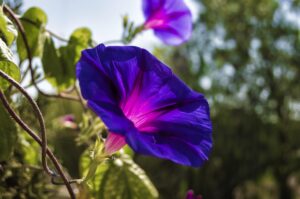
Invasive vines may climb over shrubs and trees, intercept sunlight, compete for water and nutrients, or regenerate from roots and stem fragments. Their reproductive strategies also differ, so an approach that works for a seed-producing annual may fail against a perennial vine with persistent underground growth.
In this guide , we will examine common invasive vines with blue flowers, focusing on identification features, growth habits, reproduction, and practical control methods. The goal is to help you recognize problematic vines accurately before choosing an appropriate management strategy.
10 Common Invasive Vines With Blue Flowers
1. Kudzu (Pueraria montana) – Common invasive vine with blue-purple flowers
Kudzu is a highly aggressive climbing vine recognized by clusters of purple to bluish-purple flowers and large trifoliate leaves. Its stems can spread along the ground before climbing trees, fences, and other vegetation. The plant develops extensive crowns and rooted stems that can continue producing shoots after portions of the canopy are removed.
It favors warm climates with adequate moisture and sunlight, although established plants can tolerate a range of conditions. Rapid vegetative growth allows kudzu to cover substantial areas and shade vegetation beneath its canopy. Mature vines can develop heavy stems that place additional weight on supporting trees. Seed production can also contribute to persistence, although vegetative spread is particularly important.
Young infestations are considerably easier to manage than mature colonies. Repeatedly cutting new growth can weaken plants, but cutting alone may not eliminate established root systems. Removing or treating regrowth requires continued monitoring throughout the growing season. Large infestations should be managed using locally appropriate invasive-species guidance.
Pros
- Distinct flowers
- Fast growth
- Easy identification
- Strong climbing
- Dense coverage
- Perennial growth
- Hardy
Cons
- Highly invasive
- Difficult control
- Smothers vegetation
2. Blue Morning Glory (Ipomoea indica) – Fast growing vine with blue flowers
Blue morning glory produces large funnel-shaped blue to violet flowers and heart-shaped leaves on vigorous twining stems. The stems can rapidly climb fences, shrubs, walls, and trees when suitable support is available. Twining growth allows the vine to wrap around structures and neighboring vegetation while continuously extending toward available light.
It performs particularly well in warm climates with sufficient sunlight and moisture. Dense foliage can shade smaller plants beneath the vine, reducing their access to photosynthetically active light. Depending on the population and region, vegetative growth can be more important than seed production. This makes established plants capable of recovering after substantial top growth has been removed.
Small plants are easier to remove before they develop extensive climbing stems. Repeatedly cutting new shoots can gradually reduce the plant’s ability to maintain a large canopy. Root systems should also be considered when mechanical control is used. Because Ipomoea contains many similar species, identification should be confirmed before treatment.
Pros
- Large flowers
- Rapid climbing
- Dense foliage
- Heart-shaped leaves
- Warm climate
- Vigorous growth
- Easy recognition
Cons
- Aggressive growth
- Difficult removal
- Can smother plants
3. Blue Trumpet Vine (Thunbergia grandiflora) – Climbing vine with blue flowers identification
Blue trumpet vine is recognized by large trumpet-shaped blue to lavender flowers and broad green leaves carried along vigorous climbing stems. It can spread over fences, trees, walls, and surrounding vegetation in suitable warm climates. Its vigorous vegetative growth allows the plant to maintain a substantial canopy while roots and surviving stems support regeneration.
The vine favors warm environments with adequate moisture and can develop rapidly during active growth periods. Dense foliage can block sunlight from plants underneath and occupy substantial vertical space. In regions where it has naturalized, growth beyond gardens can threaten surrounding vegetation. Its attractive flowers can therefore disguise the extent of its ecological impact.
Removing young plants before extensive establishment generally requires less effort. Cutting the canopy can suppress growth temporarily, but persistent roots and regrowth need follow-up attention. Repeated removal of new shoots can gradually weaken an established plant. Larger infestations should be approached according to local invasive-plant recommendations.
Pros
- Large flowers
- Vigorous climbing
- Dense foliage
- Easy recognition
- Warm climate
- Fast growth
- Attractive blooms
Cons
- Highly vigorous
- Persistent roots
- Difficult removal
4. Periwinkle (Vinca major) – Blue flower vine taking over trees
Periwinkle is a trailing or climbing groundcover with glossy green leaves and blue-purple flowers that can form dense mats. Long stems spread across soil and can climb through surrounding vegetation when suitable support is available. Nodes that contact moist soil can develop roots, allowing individual stems to produce additional rooted sections.
It is particularly successful in shaded or partially shaded environments where many turf and groundcover species struggle. Dense mats can suppress seedlings and native ground vegetation by occupying the soil surface and limiting available light. Small fragments can contribute to regeneration when disturbed or moved to favorable sites. These characteristics make established populations persistent in some regions.
Small patches can often be managed by carefully removing stems and roots from the soil. Follow-up inspection is important because overlooked rooted sections can produce fresh shoots. Covering cleared ground can reduce opportunities for remaining fragments and seedlings to establish. Chemical treatment, where appropriate, should be selected for the specific site and surrounding vegetation.
Pros
- Blue flowers
- Shade tolerant
- Glossy foliage
- Creeping stems
- Dense coverage
- Hardy
- Easy recognition
Cons
- Persistent
- Rooted fragments
- Can spread
5. Blue Passionflower (Passiflora caerulea) – Invasive blue flowering vine in garden
Blue passionflower produces intricate blue-and-white flowers, distinctive lobed leaves, and curling tendrils that allow it to climb. Its unusual flowers make identification easier than with many vines that have small, inconspicuous blooms. Tendrils respond to physical contact by coiling around nearby supports, giving the vine an efficient way to climb without producing adhesive discs.
The plant prefers warm conditions, sunlight, and adequate moisture, although its performance varies considerably by climate. In areas where it escapes cultivation, vigorous growth can allow it to spread across fences, shrubs, and trees. Fruit production can provide another route for reproduction when suitable pollination occurs. Its invasive status is therefore highly dependent on location.
Young plants are easier to control before climbing growth becomes extensive. Cutting the vine repeatedly can reduce canopy development, while removing unwanted root growth addresses regeneration below ground. Preventing unwanted fruit production can also reduce potential seed spread. Check regional invasive-plant lists before removing established specimens.
Pros
- Distinct flowers
- Tendril climbing
- Attractive blooms
- Easy identification
- Vigorous growth
- Warm climate
- Climbing habit
Cons
- Can spread
- Region dependent
- Dense growth
6. Cairo Morning Glory (Ipomoea cairica) – Fast-growing invasive vine with blue-purple flowers
Cairo morning glory is a vigorous perennial climber with palmately divided leaves and funnel-shaped flowers that can range from lavender to blue-purple. Its long stems can spread over fences, shrubs, walls, and trees when growing conditions are favorable. The twining stems coil around supports as they elongate, allowing the plant to gain height while directing foliage toward available sunlight. In warm regions, this rapid climbing habit can allow established plants to occupy substantial areas.
The species performs well in tropical and subtropical environments with adequate sunlight and moisture. Its extensive vegetative growth can form dense layers that shade smaller plants beneath the canopy. Regrowth from persistent underground structures can make established populations more difficult to eliminate. Because invasive behavior varies geographically, local plant lists should be consulted before determining its status.
Young plants are considerably easier to remove before their stems become extensive. Repeatedly cutting new growth can reduce canopy development, although persistent underground portions may continue producing shoots. Removing regrowth before it reaches supporting vegetation can gradually weaken an established patch. For larger infestations, control should follow locally approved invasive-plant management practices.
Pros
- Blue-purple flowers
- Rapid climbing
- Distinct foliage
- Perennial growth
- Heat tolerant
- Dense coverage
- Easy recognition
Cons
- Aggressive growth
- Persistent roots
- Difficult control
7. Common Morning Glory (Ipomoea purpurea) – Common climbing vine with blue flowers
Common morning glory produces funnel-shaped flowers that may appear blue, violet, purple, pink, or combinations of these colors. Its heart-shaped leaves and twining stems provide useful identification characteristics when flowers are absent. The vine wraps its stems around nearby supports, enabling rapid vertical growth without requiring specialized attachment structures. Under favorable conditions, this climbing strategy allows it to cover surrounding vegetation quickly.
The plant is an annual vine in many climates and reproduces primarily through seeds. Large seed production can allow populations to return in locations where mature plants are permitted to complete their reproductive cycle. Disturbed soil, fences, field edges, and gardens can provide suitable establishment sites. Its invasive or weedy status depends on the region and local environmental conditions.
Removing plants before seed capsules mature is one of the most useful management steps. Young vines can usually be pulled more easily than established plants with extensive stems. Repeated cutting can prevent flowering and reduce the number of seeds returned to the soil. Monitoring the area during subsequent growing seasons helps identify new seedlings before they become climbing vines.
Pros
- Blue flowers
- Heart-shaped leaves
- Fast climbing
- Easy identification
- Seed producing
- Warm-season growth
- Vigorous vines
Cons
- Reseeds readily
- Can smother plants
- Persistent seedbank
8. Ivy-Leaved Morning Glory (Ipomoea hederacea) – Blue flower vine growing on fences
Ivy-leaved morning glory is a twining annual vine with blue to purple funnel-shaped flowers and leaves that can become distinctly three-lobed. Its flexible stems readily climb fences, shrubs, and other supports as they grow. Twining allows the plant to position its leaves above competing vegetation, improving access to sunlight without investing heavily in woody structural tissue. The combination of rapid growth and seed production can make unwanted populations persistent.
It commonly appears in disturbed areas, agricultural settings, gardens, and open ground where suitable support is available. The plant produces seed capsules after flowering, allowing new plants to emerge during subsequent growing periods. Seeds can remain a management concern when mature plants are repeatedly allowed to reproduce. Regional conditions determine whether the species behaves primarily as a weed or an invasive plant.
Removing young vines before flowering prevents the production of new seed. Hand pulling is practical when plants are small and the soil is sufficiently loose to remove the root system. Repeatedly cutting established vines can prevent them from reaching supports and completing reproduction. Long-term management depends on reducing both existing growth and the supply of new seedlings.
Pros
- Blue flowers
- Distinct leaf shape
- Fast climbing
- Easy recognition
- Seed producing
- Annual growth
- Fence adapted
Cons
- Reseeds readily
- Rapid growth
- Can spread
9. Japanese Honeysuckle Lookalike: Blue Morning Glory (Ipomoea nil) – Blue-flowered invasive vine identification
Ipomoea nil is a vigorous twining vine that can produce large funnel-shaped flowers in blue, violet, purple, or related shades. Its leaves are generally heart-shaped to three-lobed, while the stems wrap around surrounding vegetation and structures. The twining mechanism relies on directional growth triggered by contact, allowing the stem to secure itself as it encounters a support. This climbing behavior can produce dense foliage where growth is unchecked.
The species can grow rapidly during warm weather and produces seed capsules after flowering. Mature seeds provide an important pathway for regeneration when plants are allowed to complete their reproductive cycle. Disturbed ground and garden edges can provide favorable locations for establishment. Its status varies by region, so the term invasive should be applied according to local evidence.
Control is easier before the vine becomes intertwined with desirable plants. Removing young plants and preventing seed production can substantially reduce future populations. Established vines may require repeated cutting because new shoots can emerge after the first removal. Maintaining dense desirable vegetation can also reduce exposed soil available for new seedlings.
Pros
- Large flowers
- Blue varieties
- Vigorous climbing
- Distinct foliage
- Seed producing
- Fast growth
- Easy flowering ID
Cons
- Can reseed
- Dense growth
- Region dependent
10. Blue Potato Vine (Solanum crispum) – Blue-purple flowering vine for fence identification
Blue potato vine is a woody climbing plant that produces clusters of blue to purple flowers with contrasting yellow centers. Its elongated leaves and flexible stems allow it to grow across fences, trellises, walls, and supporting vegetation. As the stems mature and become woody, they develop greater structural strength, allowing established plants to maintain larger climbing canopies. The resulting growth can become difficult to remove when stems become intertwined with surrounding plants.
It prefers mild climates and generally performs best in sunny locations with suitable moisture and well-drained soil. Established plants can occupy substantial vertical space and compete with nearby vegetation for sunlight. Its persistence varies according to climate, management, and local growing conditions. It should therefore be identified and assessed locally before being classified as invasive.
Young plants can often be removed by digging out the root system before woody growth becomes extensive. Established vines may require repeated cutting followed by careful monitoring for new shoots. Removing unwanted growth before reproductive development can help reduce further spread. Chemical treatment, where appropriate, should only use a product labeled for the intended site and target plant.
Pros
- Blue flowers
- Yellow centers
- Woody stems
- Vigorous climbing
- Easy identification
- Dense foliage
- Long-lived growth
Cons
- Woody growth
- Persistent
- Can spread
Control Strategies for Invasive Vines With Blue Flowers
Controlling an invasive vine begins with accurate identification, because blue-flowered vines include native plants, ornamentals, and species that are invasive only in particular regions.
Manual Removal
- Remove young vines
- Extract roots
- Collect fragments
- Monitor regrowth
Small infestations are often easier to manage before vines become intertwined with trees, shrubs, or structures. Remove as much of the root or crown system as practical rather than simply pulling away the visible canopy.
Repeated Cutting
- Cut new shoots
- Prevent flowering
- Reduce seed production
- Monitor frequently
Repeated cutting can gradually weaken some perennial vines by continually removing photosynthetic growth. However, cutting alone may be insufficient when underground structures remain capable of producing new shoots.
Prevent Climbing
- Cut early
- Protect trees
- Remove supports
- Inspect fences
Stopping a young vine before it reaches trees or shrubs can dramatically simplify management. Mature vines can create dense canopies, making removal more labor-intensive and increasing the risk of damaging desirable vegetation.
Mulching and Ground Cover
- Cover bare soil
- Block seedlings
- Reduce disturbance
- Maintain coverage
Mulching can suppress germination and reduce exposed soil available for annual vines. Dense desirable vegetation also limits opportunities for invasive seedlings to become established.
Herbicide Management
- Identify species
- Choose labeled product
- Follow directions
- Protect desirable plants
Herbicides should be selected according to the specific plant, site, and surrounding vegetation rather than simply by flower color. Always follow the product label and applicable local requirements.
Invasive Vine With Blue Flowers FAQs
1. What is an invasive vine with blue flowers?
It is a climbing or trailing plant that produces blue or blue-purple flowers and has the potential to spread aggressively outside its intended growing area. However, invasive status is geographically specific, so the exact species and location matter.
2. How can I identify a blue-flowered invasive vine?
Examine the flowers, leaves, stems, climbing mechanism, seed capsules, and root system together. A photograph of the entire plant is generally more useful for identification than a close-up of the flower alone.
3. Are all blue-flowered vines invasive?
No. Some are native wild plants or intentionally cultivated ornamentals. Never classify a vine as invasive solely because it grows quickly or produces blue flowers.
4. Why do invasive vines grow so quickly?
Many vigorous vines invest heavily in rapid stem and leaf production, allowing them to reach sunlight efficiently. Some also combine seed reproduction with vegetative growth, increasing their ability to occupy new areas.
5. Can cutting an invasive vine kill it?
Cutting can suppress the canopy but may not eliminate a perennial vine. Plants with persistent roots, crowns, rhizomes, or rooted stems can regenerate after above-ground growth is removed.
6. Should I remove a blue-flowered vine from a tree?
If the species is confirmed to be invasive, early removal can prevent further spread and shading. Large vines should be assessed carefully because pulling mature growth from trees can damage branches or create falling-material hazards.
7. What is the most effective way to prevent invasive vines?
Inspect plants before introducing them, remove unwanted seedlings early, prevent mature vines from producing seeds, and regularly inspect fences, trees, garden boundaries, and disturbed areas. Early intervention is generally much easier than controlling a mature infestation.
Conclusion
In conclusion, identifying an invasive vine with blue flowers requires more than recognizing its flower color because several unrelated species share similar blooms. Leaf structure, climbing method, reproductive strategy, root system, and regional invasive status provide the information needed for a reliable identification.
Kudzu, blue morning glory, blue trumpet vine, periwinkle, and other vigorous vines can behave very differently depending on climate and habitat. Understanding whether a plant spreads through seeds, persistent roots, rooted stems, or several mechanisms at once helps determine the appropriate management approach.
Early removal is usually far easier than controlling a mature vine that has already climbed trees or formed a dense canopy. Regular inspections, prevention of seed production, prompt removal of young plants, and follow-up monitoring can substantially reduce the likelihood of a recurring infestation.
Before removing any blue-flowered vine, confirm its identity and check its invasive status in your region. If it is genuinely invasive, choose a control method suited to its biology and site, then act early to prevent the plant from becoming a much larger management problem.
Recent Posts
Spring fertilization supports healthy leaf development, root activity, and productive shoot growth when apple trees have insufficient soil nutrients. Selecting an appropriate fertilizer requires...
Cucumbers (Cucumis sativus) are vigorous, fast-growing vines that can produce abundant harvests when their roots receive enough water, warmth, and balanced nutrition. The best fertilizer for cukes in...