The best herbicide for ragweed depends on where the weed is growing, how mature the infestation has become, and whether desirable plants must be protected. Ragweed is a broadleaf weed that can become particularly troublesome in lawns, pastures, roadsides, non-crop areas, landscapes, and agricultural settings, so the right herbicide should always be matched to the site and the product label.
Ragweed (Ambrosia artemisiifolia) is a common and troublesome weed known for its ability to spread rapidly and cause allergies. If left unchecked, it can quickly invade gardens, fields, and pastures. Fortunately, selecting the right herbicide can effectively manage Ragweed and prevent it from becoming a persistent problem.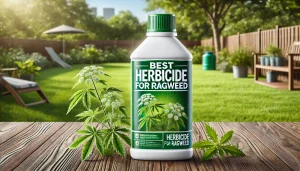
Ragweed control is generally easier when plants are young and actively growing rather than when large, mature plants have already produced extensive root systems or seeds.
Another important consideration is the difference between post-emergence and pre-emergence control. Post-emergence herbicides target ragweed that is already growing, while residual or pre-emergence herbicides can help prevent susceptible weeds from establishing when the product is specifically labeled for that use.
In this guide, the 10 best herbicides for ragweed are evaluated according to active ingredient, weed-control spectrum, selectivity, application setting, residual activity, and practical usefulness.
10 Best Herbicides for Ragweed
1. Roundup (Glyphosate) – Best Overall Herbicide for Ragweed

- Roundup Weed & Grass Killer₄ kills tough weeds and grasses to the root, including dandelion, crabgrass, poison ivy, clover (red & white), spotted spurge, and other broadleaf weeds
- It is rainproof in as fast as 30 minutes and produces visible results in hours

Roundup is the best overall herbicide for ragweed when the objective is broad-spectrum vegetation control and desirable plants are not intended to remain in the treated area. Glyphosate is a non-selective herbicidal active ingredient that controls a broad range of grasses and broadleaf weeds. EPA identifies glyphosate as an active ingredient used in products such as Roundup for weed control in both agricultural and non-agricultural settings.
Glyphosate is particularly useful for spot treatment of ragweed in areas where surrounding vegetation can be avoided. Because it is non-selective, however, spray contacting desirable plants can injure or kill them, making careful application and drift management important. The product formulation and approved uses can differ considerably between Roundup-branded products, so the label on the specific container should determine where and how it may be used.
For this reason, Roundup is particularly valuable around non-crop areas, fence lines, cracks, bare ground, and other locations where preserving surrounding vegetation is not the primary objective. It should not automatically be considered the best choice for a lawn or pasture containing desirable grasses. Overall, glyphosate provides a versatile option when broad-spectrum ragweed control is required.
Pros:
- Broad-spectrum weed control
- Controls broadleaf weeds
- Effective on actively growing vegetation
- Useful for non-crop areas
- Available in multiple formulations
- Useful for spot treatment
- Widely recognized active ingredient
Cons:
- Non-selective
- Can injure desirable plants
- Product labels differ by formulation
2. 2,4-D (Weed B Gon) – Best Selective Herbicide for Ragweed in Lawns

- Carefentrazone-ethyl - 0.62% 2,4-D 2-ethylhexyl ester - 28.57% Mecoprop-p Acid - 5.88% Dicamba Acid - 1.71%
- HOW TO APPLY: FOR ORTHO HOSE-END SPRAYERS FOR COOL-SEASON TURFGRASS For Ortho Dial’N
2,4-D is the best selective herbicide for ragweed in suitable lawns and grass-dominated areas when the specific product is labeled for the target site. 2,4-D is a broadleaf herbicide that has been widely used for decades and is registered for numerous applications, including turf, lawns, rights-of-way, forestry, aquatic sites, and agricultural settings.
Selective herbicides can be valuable in grass-dominated areas because they target broadleaf weeds while preserving appropriately tolerant grasses, whereas non-selective products are more appropriate where desirable vegetation is not present.
Its major advantage is selectivity toward many broadleaf weeds when used according to the label, allowing appropriately tolerant turfgrass to remain while susceptible broadleaf weeds are controlled. Ragweed is a broadleaf weed, making 2,4-D-based products a logical option where the label specifically includes the weed and turf species involved. However, different formulations can contain different active ingredients or combinations, so the actual product label should always be checked.
Young, actively growing ragweed is generally a more favorable target than mature plants that have already developed extensively. Additionally, preventing seed production is important because ragweed can replenish an infestation if plants are allowed to mature. Overall, properly labeled 2,4-D products are among the most useful options for ragweed growing in compatible turf and grass settings.
Pros:
- Selective broadleaf control
- Useful in compatible lawns
- Effective against many broadleaf weeds
- Widely available
- Useful for young weeds
- Multiple formulations available
- Suitable for several labeled settings
Cons:
- Can injure sensitive plants
- Formulations differ
- Must be used according to the label
3. Crossbow – Best Broadleaf Herbicide Combination for Ragweed
Crossbow is the best herbicide combination for ragweed in suitable non-crop and grassland settings because it combines triclopyr and 2,4-D. These active ingredients provide a broader broadleaf-weed control approach than relying on one chemistry alone. Crossbow formulations are intended for specific sites and vegetation-management situations, so the current product label should determine whether the target ragweed infestation qualifies.
The combination is particularly useful where a diverse population of broadleaf weeds is present rather than ragweed alone. Triclopyr and 2,4-D are both herbicidal growth-regulator chemistries, making them useful tools for managing susceptible broadleaf vegetation. EPA identifies triclopyr uses across pasture, rangeland, forestry, turf, rights-of-way, and other vegetation-management settings.
Crossbow should not be treated as a universal lawn herbicide because its approved uses and tolerances depend on the specific formulation and site. It is better viewed as a vegetation-management product for labeled applications where broadleaf control is required. Overall, it can be a strong choice for ragweed when the site and current label align.
Pros:
- Contains two active ingredients
- Strong broadleaf-weed focus
- Useful for mixed weed populations
- Suitable for certain grassland settings
- Useful in vegetation management
- Systemic activity
- Broad application potential
Cons:
- Not appropriate for every lawn
- Can injure susceptible vegetation
- Label restrictions vary
4. Garlon 4 – Best Triclopyr Herbicide for Ragweed

- Target Pests: 55 woody plants and more than 25 tough-to-control annual and perennial broadleaf weeds in noncrop areas - High-anxiety woody species - Cherry, loblolly pine, mesquite, red oak, sweetgum and Scotch broom. See Product label for all listed pests.
- For use In: Roadsides, railroads, pipelines, industrial sites, forests, grazing areas, and rights-of-way such as power lines - establishment and maintenance of wildlife openings and can be used on sites that include grazed areas. See Product label for complete list.
Garlon 4 is the best triclopyr-based herbicide for ragweed in appropriate non-crop and vegetation-management situations. Its active ingredient is triclopyr, a selective herbicide used primarily for controlling susceptible woody plants and broadleaf weeds. EPA label information identifies Garlon 4 for woody plants and broadleaf weeds in settings including rangeland, permanent grass pastures, forests, non-crop areas, roadsides, and natural areas.
This makes Garlon 4 particularly relevant when ragweed occurs alongside other troublesome broadleaf vegetation. Its systemic action allows susceptible plants to absorb the herbicide and move it within their tissues, contributing to gradual decline rather than simply producing rapid surface injury. However, the formulation is not intended to be treated as a general-purpose product for every garden or lawn.
Because triclopyr can affect susceptible broadleaf plants, protecting desirable trees, shrubs, flowers, and other sensitive vegetation is essential. Furthermore, the specific Garlon formulation and current label determine approved uses and restrictions. Overall, Garlon 4 is a specialized but powerful option for appropriately labeled vegetation-management sites.
Pros:
- Triclopyr-based
- Controls susceptible broadleaf weeds
- Useful in non-crop areas
- Suitable for certain pastures
- Useful in forestry settings
- Systemic activity
- Broad vegetation-management applications
Cons:
- Not a general lawn product
- Can injure desirable broadleaf plants
- Requires careful label compliance
5. Milestone – Best Herbicide for Ragweed in Pastures

- Target Pests: . See Product label for all listed pests.
- For use In: Rangeland, permanent grass pastures, CRP Acres, non-cropland areas, non-irrigation ditch banks, natural areas, and grazed areas in and around these sites. See Product label for complete list.
Milestone is the best herbicide for ragweed in suitable pasture and rangeland applications when long-lasting broadleaf weed management is important. Its active ingredient is aminopyralid, a systemic herbicide used for controlling susceptible broadleaf weeds in certain grassland and vegetation-management situations. EPA’s registration-review information includes aminopyralid among registered herbicide ingredients used in appropriate agricultural and vegetation-management settings.
Milestone is especially useful when ragweed occurs as part of a larger broadleaf weed complex. Because aminopyralid is systemic, susceptible plants can take up the herbicide and transport it internally, resulting in progressive growth suppression and eventual plant death. The product’s approved uses, grazing restrictions, crop restrictions, and other precautions must be checked carefully before use.
Aminopyralid products also require particular attention to stewardship because residues can affect sensitive broadleaf plants through treated forage, manure, compost, or soil pathways depending on the specific product and use. Consequently, Milestone should be selected primarily when its label and the management objectives of the site align. Overall, it is a valuable specialized option for ragweed in appropriate grassland environments.
Pros:
- Systemic activity
- Strong broadleaf focus
- Useful in pasture management
- Suitable for rangeland applications
- Controls susceptible weeds
- Useful for established infestations
- Long-lasting vegetation-management potential
Cons:
- Strict use restrictions may apply
- Can affect sensitive broadleaf plants
- Not suitable for every landscape
6. Tordon 22K – Best Herbicide for Large Ragweed Infestations

- NOT For Sale In: AK, CA, DC, FL, RI, PR
- Effective: Kills cut stumps on fence lines&non-cropland areas. Control unwanted trees by cut surface treatments in forest&non-crop areas such as fence rows, roadsides&rights-of-way
Tordon 22K is the best herbicide for large ragweed infestations in appropriately labeled rangeland and non-crop situations where persistent broadleaf weed control is required. Its active ingredient is picloram, a systemic herbicide used against susceptible broadleaf weeds in several vegetation-management settings. EPA lists picloram among herbicides registered for uses including pasture, rangeland, forests, conservation areas, rights-of-way, and related sites.
Picloram is particularly important to treat as a specialized vegetation-management chemistry rather than a casual backyard weed killer. Its persistence and activity against susceptible broadleaf vegetation can make it useful in large-scale management programs, but those same characteristics mean that off-target movement and planting restrictions must be taken seriously. The exact approved use must always come from the current label for the product being purchased.
Tordon 22K can therefore be valuable where ragweed is part of a broader rangeland weed problem. However, homeowners should not assume that a product approved for rangeland or rights-of-way is automatically appropriate for lawns, gardens, vegetable beds, or ornamental landscapes. Overall, it is a specialized choice best suited to qualified, labeled vegetation-management situations.
Pros:
- Strong systemic activity
- Useful for broadleaf weeds
- Suitable for certain rangeland applications
- Useful for large infestations
- Long-lasting activity
- Valuable for vegetation management
- Controls susceptible established weeds
Cons:
- Highly site-specific
- Persistence requires careful stewardship
- Not suitable for general garden use
7. Outlook – Best Pre-Emergence Herbicide for Ragweed

- Use with most pesticides to improve results
Outlook is the best pre-emergence option in this list for preventing susceptible ragweed from establishing where the product is specifically labeled for that use. Its active ingredient is dimethenamid-P, a Group 15 herbicide that provides residual control of susceptible annual grasses and broadleaf weeds as they germinate. EPA label information describes Outlook as a selective residual herbicide for controlling many annual grasses, annual broadleaf weeds, and sedges as they germinate.
This makes Outlook fundamentally different from glyphosate, 2,4-D, or triclopyr products that are commonly used against weeds that are already emerged. Pre-emergence herbicides are most useful as part of a preventive program because they target susceptible weeds during germination and early establishment. Consequently, timing and the specific crop or site listed on the current label are critical.
Outlook can be particularly valuable when the goal is to reduce future weed pressure rather than simply remove visible mature ragweed. However, it should not be assumed to control every ragweed species or infestation in every setting. Overall, Outlook is best considered a preventive tool within a broader integrated weed-management program.
Pros:
- Residual activity
- Pre-emergence control
- Targets germinating weeds
- Selective chemistry
- Useful for prevention
- Controls multiple weed groups
- Can complement post-emergence programs
Cons:
- Does not replace post-emergence control
- Site restrictions apply
- Weed spectrum varies by label
8. Gallery – Best Residual Herbicide for Landscape Settings

- Gallery specialty herbicide provides season-long control of more than 90 species of broadleaf weeds.
- Gallery provides superior preemergence broadleaf weed control with best-in-class ornamental and turf safety
Gallery is the best residual herbicide option in this list for appropriate ornamental and landscape settings when preventing susceptible annual broadleaf weeds is the objective. Importantly, Gallery products are associated with isoxaben, not imazethapyr, so the active ingredient should be corrected from the information in the original list. EPA product information identifies Gallery 75 Dry Flowable and Gallery SC formulations with isoxaben as the active ingredient.
Gallery works primarily as a pre-emergence herbicide, meaning its value comes from preventing susceptible weed seedlings from successfully establishing rather than killing large mature ragweed plants. This makes it most useful as part of a preventive landscape-management program. The exact weed spectrum and approved ornamental uses depend on the specific Gallery formulation and current label.
For this reason, Gallery should not be presented as a universal post-emergence ragweed killer. Instead, gardeners should verify that the specific formulation lists the target weed, landscape site, and intended ornamental plants before using it. Overall, Gallery can be a valuable residual tool where its label permits the intended application.
Pros:
- Pre-emergence activity
- Useful residual control
- Suitable for certain landscape settings
- Helps prevent weed establishment
- Isoxaben-based formulations
- Useful around appropriate ornamentals
- Can complement other weed-management methods
Cons:
- Does not control established mature ragweed effectively
- Product formulations differ
- Label-specific plant tolerances apply
9. Chateau – Best Flumioxazin Herbicide for Ragweed Prevention

- POWERFUL BRUSH & WEED CONTROL: Specifically formulated with the active ingredient Triclopyr to stop encroaching brush and tackle tough broadleaf weeds all year round. Ideal for reclaiming large tracts of overgrown land or selectively enhancing sensitive sites.
- VERSATILE APPLICATION AREAS: Perfect for use in rangelands, permanent grass pastures, Conservation Reserve Program (CRP) acres, fencerows, and non-irrigation ditch banks. Preserve and increase the value of your property with professional-grade clearing.
Chateau is the best flumioxazin-based option in this list for appropriate residual weed-management programs where ragweed prevention is part of the objective. Flumioxazin is a Group 14 herbicide used in a variety of agricultural, ornamental, and vegetation-management applications depending on the formulation and label. EPA label records identify Chateau formulations containing flumioxazin.
Its major role is generally associated with residual and pre-emergence weed management, although specific formulations can have additional labeled uses. Consequently, Chateau should be selected according to the exact crop, landscape, or vegetation-management site rather than simply because ragweed is present. The product’s effectiveness also depends on the weed species, soil conditions, application timing, and other label requirements.
Chateau can be particularly valuable in programs designed to reduce new weed establishment rather than relying entirely on post-emergence control. Furthermore, using different herbicide modes of action as part of an integrated program can help reduce reliance on one chemistry. Overall, Chateau is a specialized residual herbicide that can have a useful role when the label supports the intended application.
Pros:
- Residual activity
- Flumioxazin-based
- Useful for pre-emergence programs
- Broad weed-management utility
- Can help prevent establishment
- Useful in selected landscape settings
- Different mode of action from glyphosate
Cons:
- Not a universal ragweed killer
- Crop and site restrictions apply
- Requires careful product selection
10. Clearcast – Best Imazamox Herbicide for Specialized Ragweed Control

- ClearCast is highly effective at controlling a wide range of invasive and nuisance aquatic plants, including emergent, floating, and submerged species
- ClearCast is the best cattail solution for year-round suppression of cattails and other aquatic/semi-aquatic plants
Clearcast is the best specialized imazamox herbicide in this list for appropriately labeled aquatic and vegetation-management applications where susceptible broadleaf weeds are present. Its active ingredient is imazamox, an ALS/AHAS-inhibiting herbicide that is absorbed by foliage and roots and translocated toward growing points. The current EPA label describes Clearcast as an aquatic herbicide and specifically emphasizes following labeled application requirements and resistance-management practices.
Clearcast is therefore quite different from common homeowner lawn products. It is particularly associated with aquatic and riparian weed management, where product placement and selectivity can be important. Because imazamox belongs to Group 2, resistance management is also important, and the label specifically recommends not relying on a single herbicide mode of action.
For ragweed control, Clearcast should only be considered where the specific formulation and current label include the target weed and intended site. It should not be presented as a general-purpose product for ordinary lawns or gardens. Overall, it is a specialized option for professionals and properly labeled vegetation-management situations.
Pros:
- Systemic activity
- Imazamox-based
- Useful in aquatic vegetation management
- Absorbed through foliage and roots
- Translocated within susceptible plants
- Provides broad vegetation-management utility
- Useful within resistance-management programs
Cons:
- Specialized product
- Not a general lawn herbicide
- Label restrictions are important
7 Buyers Guide Tips for Choosing the Best Herbicide for Ragweed
1. Identify Where the Ragweed Is Growing
The first consideration should always be the treatment site. A product suitable for rangeland, forestry, aquatic vegetation, or rights-of-way may not be appropriate for a residential lawn, ornamental bed, vegetable garden, or pasture.
2. Determine Whether You Need Post-Emergence or Pre-Emergence Control
If ragweed is already visible and actively growing, a suitable post-emergence herbicide may be required. If the objective is to prevent new plants from emerging, a properly labeled residual or pre-emergence herbicide may be more appropriate.
3. Consider Selectivity
Choose a selective product when desirable grass or other tolerant vegetation needs to remain unharmed. A non-selective product such as glyphosate can damage desirable plants that receive spray, making it more appropriate for situations where surrounding vegetation can be protected or is not intended to remain.
4. Check the Active Ingredient
Do not choose a herbicide based solely on the brand name. Different products can contain different active ingredients, and even products under the same brand family can have different formulations and approved uses.
5. Target Ragweed Before It Produces Seed
Controlling ragweed before seed production is an important part of reducing future infestations. Mature plants can contribute large quantities of seed to the soil seedbank, making long-term management more difficult.
6. Rotate Herbicide Modes of Action
Repeatedly relying on one herbicide mode of action can contribute to resistance problems. EPA’s Clearcast label specifically emphasizes resistance management and avoiding reliance on a single mode of action.
7. Read the Current Product Label
The pesticide label is the controlling source for approved sites, target weeds, rates, protective requirements, restrictions, and other directions. EPA maintains a searchable pesticide-label database where users can locate product labels by product name, active ingredient, company, or registration number.
Best Herbicide for Ragweed FAQs
1. What is the best herbicide for ragweed?
The best herbicide depends on where the ragweed is growing. Glyphosate can be useful for non-selective control, while 2,4-D and suitable triclopyr products can be useful for susceptible broadleaf weeds in compatible grass-dominated sites.
2. What herbicide kills ragweed but not grass?
A properly labeled selective broadleaf herbicide such as a suitable 2,4-D product can control ragweed while preserving tolerant turfgrass. However, selectivity depends on the exact product, grass species, formulation, and label.
3. Does Roundup kill ragweed?
Yes, glyphosate products can control susceptible ragweed because glyphosate is a broad-spectrum herbicide that controls broadleaf weeds and grasses. Because it is non-selective, however, desirable plants contacted by the spray can also be injured or killed.
4. What is the best herbicide for ragweed in lawns?
A selective broadleaf herbicide labeled for the particular turfgrass and ragweed species is generally a better choice than a non-selective product. 2,4-D-based products are commonly used for broadleaf weed control, but the specific formulation must be labeled for the lawn and turfgrass involved.
5. Can pre-emergence herbicides prevent ragweed?
Yes, appropriately labeled residual herbicides can prevent susceptible ragweed seedlings from establishing when used as part of a preventive weed-management program. Products such as Outlook, Gallery, and certain Chateau formulations have residual or pre-emergence roles, but their exact target weeds and approved sites differ.
6. What is the strongest herbicide for large ragweed infestations?
There is no single herbicide that is universally strongest for every ragweed infestation. Products containing glyphosate, triclopyr, aminopyralid, or picloram can have important roles in different vegetation-management settings, but the correct choice depends on the site, desirable vegetation, ragweed species, and current label.
7. How do I prevent ragweed from coming back?
Preventing seed production is one of the most important steps because mature ragweed can replenish the soil seedbank. Combining appropriate herbicide use with mowing, competitive vegetation, sanitation, and monitoring can provide more durable control than relying on herbicides alone.
Final Verdict
The best herbicide for ragweed overall is Roundup containing glyphosate when broad-spectrum vegetation control is appropriate and desirable plants can be protected. Because glyphosate is non-selective, however, it should be reserved for situations where contacting surrounding vegetation is not a concern.
For ragweed growing in lawns, a properly labeled 2,4-D herbicide is generally a better choice because it can target susceptible broadleaf weeds while preserving compatible turfgrass. For pastures, rangelands, roadsides, and other specialized sites, products containing triclopyr, aminopyralid, or picloram can provide effective options when their labels specifically permit the intended application.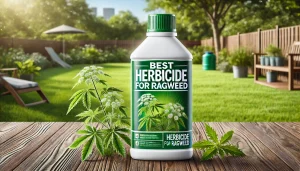
If your main objective is preventing the next generation of ragweed, residual and pre-emergence herbicides such as Outlook, Gallery, or appropriate Chateau formulations can have an important role. However, these products should not be treated as interchangeable because their active ingredients, approved sites, target weeds, and application requirements differ.
Ultimately, the best herbicide for ragweed is the one that matches the weed, the growing site, and the desirable vegetation you need to protect. Treat ragweed while it is actively growing and before it produces seed whenever possible, rotate herbicide modes of action where appropriate, and always follow the current product label for the exact formulation you are using.
Recent Posts
Spring fertilization supports healthy leaf development, root activity, and productive shoot growth when apple trees have insufficient soil nutrients. Selecting an appropriate fertilizer requires...
Cucumbers (Cucumis sativus) are vigorous, fast-growing vines that can produce abundant harvests when their roots receive enough water, warmth, and balanced nutrition. The best fertilizer for cukes in...